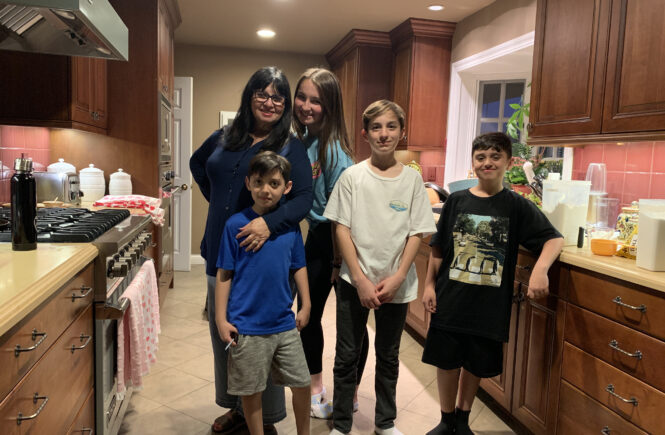

I can’t imagine my life without Christ. And the more aware I become of the circumstances around me, the deeper the dive.
Being a content creator comes with both advantages and disadvantages. To amplify the Word of God using Jesus as the model is a bit challenging — because the human aspect always takes precedence, inserting thoughts that are not Jesus’ style.
More than anything, I want to emulate Him. His tender mercies and special graces seem far-reaching in this world, but nonetheless, endurance is my education.
It Starts With Prayer
We all have it! This wonderful gift from God is so very simple: Jesus, help me! Jesus, open my mind to receive You! Jesus, guide my everyday thoughts and pour Your holy wisdom over me. But when incorporating the Rosary or the Divine Mercy Chaplet into your daily prayer, the doors to heaven are opened wider. Do you want to grow in your walk? Talk to your Maker, and He will see you through your journey.
Living in Southern California, we know our freeways. We never speak in miles — only in minutes. So if you’re traveling to Los Angeles, there are many different routes available. It’s a journey. Taking surface streets could delay your arrival. If there is an accident on the freeway, slowing down will cost you time. In the same way, when you start your journey with God, you will experience many roadblocks. But if you continue to trust God, even the biggest obstacles will be removed.
The Destination
Let this be stated plainly: this journey has a final destination. Heaven or Hell. The choice belongs to each soul.
So how does one get to Heaven? The answer is not as hidden as it seems — because deep within the human spirit, the signs are already there. The coworker who has been quietly witnessing. The mother whose prayers, like Saint Monica’s, never giving up. These are not coincidences. They are signposts, placed by a God who does not abandon anyone without first sending them a guide.
But the will — now that is where it becomes complicated. The will is a merciful and extraordinary gift from God. And it is precisely what the enemy targets. The mass confusion generated by social media, by competing voices, by a culture that mistakes lies for truth — all of it presses against the will, distorting it, dulling it, pulling it away from what it was made for.
The Boundary That Becomes a Prison
The boundaries human beings set will become a hindrance whenever they seek to limit God. When a trial enters a believer’s life, the instinct to turn toward God often rises naturally — crying out for His comfort, pleading that the pain of brokenness would pass. This is good. This is grace at work.
But the trial is not the whole of the lesson.
Yet for some, once the trial fades, the soul retreats. They tell themselves God is in my heart — and then quietly step back from the sacraments, from the community of the Church, from the regular rhythm of prayer and confession. The fear remains. The emotional wound lingers, just beneath the surface. And in pride, or weariness, or confusion, the soul convinces itself it can manage alone.
This is where the enemy finds his opening.
At this point of vulnerability, the mind — like clockwork — returns to the incident. The emotion that once drove the soul to its knees is still present, still active, still unresolved — not because God failed to answer, but because the soul chose to go around God rather than through Him. Relief was mistaken for healing. Survival was mistaken for transformation. And the wound that was never fully surrendered continues to speak, quietly and persistently, it will not leave until a full surrender.
The lesson of every trial, then, is not merely endurance. It is deeper dependence — dependence that does not end when the pain ends, but matures into a daily, chosen surrender to the One who holds all things.
Be Transformed
Saul of Tarsus was not a passive sinner — he was an aggressive one. He traveled to Damascus with papers in hand, authorized to arrest and destroy those who belonged to the Way. He was moved by his harden heart, that only God could stop.
And then — the light.
In an instant, the persecutor was on the ground. The voice that spoke was not a vision or a feeling or an impression. It was Christ Himself: “Saul, Saul, why are you persecuting me?” (Acts 9:4). Three days of blindness followed. No food. No water. Only darkness — and the slow, devastating realization that everything he had been certain of was wrong. Humbleness that stood the test of time.
The blindness was not punishment. It was preparation.
When Ananias laid hands on him and the scales fell from his eyes, what emerged was not merely a changed man — it was a new creation. So total was the transformation that even his name was changed. Saul became Paul. The transformation immediate, the destroyer became the one who would suffer all things for the sake of the very Gospel he had once tried to extinguish.
This is what genuine conversion looks like. It is not self-improvement. It is death and resurrection. It’s a feeling of wholeness.
The world today is suffering its own form of blindness — not like the dramatic blindness of the Damascus road, but something slower and more insidious. A blindness that accumulates quietly, fed by pride, distraction, and a culture that has mistaken noise for wisdom, suddenly only their beliefs is all that matters. Many cannot see what they have lost because they do not allow God into their harden hearts.
But the same God who stopped Saul on the road to Damascus has not changed. He is still the healer of harden hearts and the One who gives vision to the spiritually blind.
The only question is whether the soul, when it finds itself on the ground, will stay there long enough to hear the voice — or whether it will rise too quickly, brush off the dust, and continue in the direction it was already headed.
Transformation is for the rest of a life.
The Saint Who Was Chosen Before I Knew
At Confirmation, the choosing of a saint’s name can feel intimidating. At the time, I did not fully understand the full weight of choosing a saint. With my mother’s gentle guidance, the name was chosen: Saint Margaret of Hungary. The reason was simple and human — my grandmother’s name is Margarita. A family thread. A name that felt familiar.
God was already at work in what looked like sentiment.
It was not until recently, when that saint’s name was required for the Sacrament of Marriage in the parish, that the full picture began to come into focus. Saint Margaret of Hungary — a princess who renounced privilege, and poured her life out in service to the poor — was not a random selection. She was a signpost placed long before the road was visible.
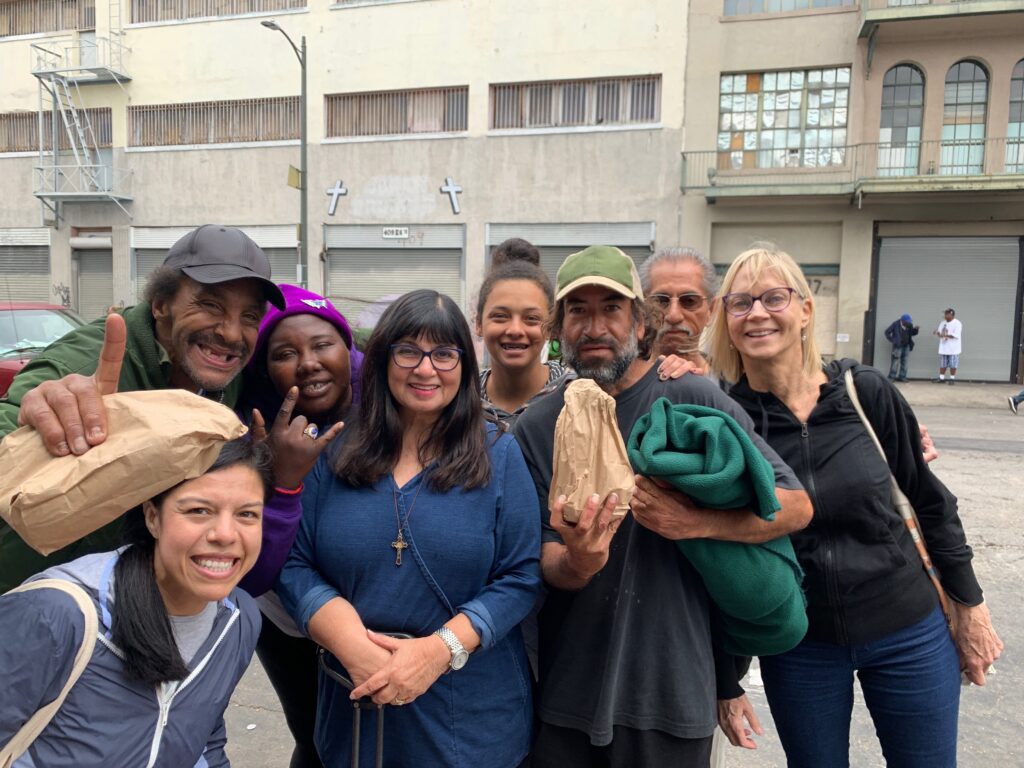
For twenty years, that same road led me to Skid Row in Los Angeles — one of the most concentrated epicenters of human suffering in the country. There, the pattern of Margaret’s life became flesh in me. Once a month, with 300 packed lunches, the homeless were served. But more than meals were distributed: prayer was offered. Dignity was restored. The princess who renounced a throne was living again through me—not symbolically, but actually.
God Knew
He knew before the name was chosen. He knew before the work began. He had already written the connection between a Hungarian princess who died in 1270 and a soul who would one day kneel beside the broken on the streets of Los Angeles. The saints intercede. They are our companions. They are given to us not by accident but by divine intention.
This is what the Church means when she speaks of the Communion of Saints — a mystical solidarity that crosses centuries, transcends death, and binds every baptized soul to one another and to Christ who is their Head.
The name chosen in ignorance was chosen in grace.
My Prayer
Lord continue to gently move on the lost souls of the world. As You did for Saint Paul, remove the scales from their eyes. Amen