

Biola University
While living as a Born-Again Christian, a decision was made to complete a degree at Biola University. Among the required courses was a study of the Book of Acts — and it was there that Saul of Tarsus came alive on the page. Saul was on a mission to destroy the early Church. He operated with cold precision, securing the proper legal documentation to bring followers of Jesus back to Jerusalem to stand trial before the Sanhedrin — the supreme governing council of ancient Israel, foundational to the religious, legal, and social life of the Jewish people during the Second Temple period. This council was composed of chief priests, elders of the people, and scribes learned in the law.
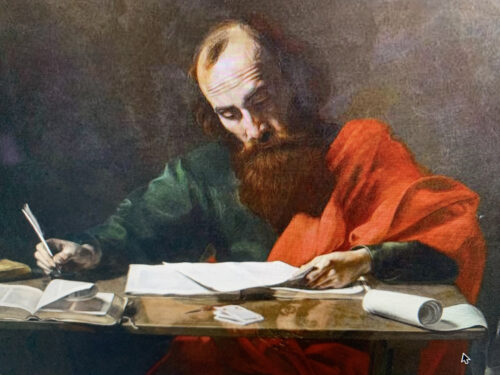
Saul
But God had a greater plan.
Saul was not simply zealous — he was formidably equipped. The famous rabbi Gamaliel, a member of the Sanhedrin Council, was Saul’s teacher — the most highly respected scholar of his generation. Saul was a Pharisee, a Roman citizen by birth through his father (Acts 16:37), a tentmaker by trade, and fluent in both Hebrew and Greek. He was relentless in his pursuit of the early Christians, determined to bring them to trial and, if possible, to their deaths.
Yet God wasted nothing. Every skill Saul had honed in the service of persecution, God redirected in the service of proclamation. His zeal did not disappear at his conversion — it was transformed. The same fire that drove him to hunt Christians would now drive him to the ends of the known world to make them.
Even his trade served the mission. A tentmaker was never without work — Roman soldiers were required to serve for twenty-four years, their deployments stretching across Asia Minor and the Holy Land, and every one of them needed shelter. God used Saul’s hands to fund what God had placed in his heart.
While I was living my life as a Born Again Christian, I decided to finish my education at Biola University. As part of the curriculum, one of the classes included a study on the Book of Acts. This introduced me to Saul of Tarsus. Saul was on a mission to destroy Christians. He covered all his legal bases by making sure that he had the proper documentation to bring Jesus’ followers back to Jerusalem to stand trial before the Sandhedrin, the governing assembly of rabbis appointed with legal authority in ancient Israel.
The Road to Damascus
On his way to Damascus, Saul was stopped in his tracks — struck down by a light so blinding it brought him to the ground. The man who had never been stopped by anyone or anything was suddenly helpless in the dust.
Acts 9:4–6 (New American Bible, Revised Edition)
“He fell to the ground and heard a voice saying to him, ‘Saul, Saul, why are you persecuting me?’ He said, ‘Who are you, sir?’ The reply came, ‘I am Jesus, whom you are persecuting. Now get up and go into the city and you will be told what you must do.'”
When Jesus asked, “Saul, Saul, why are you persecuting me?” — Saul had no category for the question. He did not yet know who Jesus was, because he was spiritually blind. Yet he recognized immediately that the voice was divine. This was not a vision. This was not a dream. This was an encounter with the living God — and nothing would ever be the same.
The message beneath the question was unmistakable: whatever is done to the least of His followers is done to Him. Saul had not merely been hunting Christians. He had been laying hands on Christ.
For three days, Saul neither ate nor drank. He fasted, he prayed, and he waited in darkness — until the scales fell from his eyes and he could finally see. What he saw changed everything. From that moment forward, Saul was no longer a destroyer of the Church. He would become one of its greatest architects.
He later took up his Roman name, Paul — a deliberate choice as his mission carried him deeper into Gentile territory, where he became, in a sense, all things to all people so that he might win some for Christ (cf. 1 Corinthians 9:22). The man who once signed arrest warrants for believers would go on to write nearly half of the New Testament, shaping the theology and spiritual imagination of the Church for two thousand years.
Discovering Your Gifts
How does a person discover what they have been given? For some, gifts emerge naturally — almost effortlessly. For others, the path runs through suffering, failure, and hard-won lessons. St. Paul belonged to that second company. So do I.
Every misgiving, every act of disobedience, every season of stubbornness and self-righteousness — none of it was wasted. All of it, eventually, brought me to my knees. And from my knees, the truth became undeniable: I am nothing without Christ.
Acts 9:15–16 (New American Bible, Revised Edition)
“But the Lord said to him, ‘Go, for this man is a chosen instrument of mine to carry my name before Gentiles, kings, and Israelites, and I will show him what he will have to suffer for my name.'”
Through prayer, the scales finally fell from my eyes as well. The deeper I searched for holiness, the less I desired what the world was offering. Slowly, quietly, my priorities were reordered — and I began to see our family’s life differently.
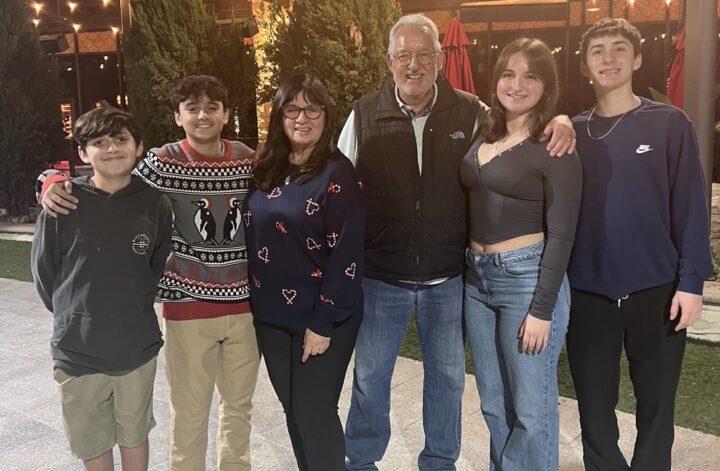
We are a family that lives within our means. Through Mike’s example, our children learned early that work is not a burden but a dignity. God gave us the means to educate them, and now our responsibility is to keep them in prayer and to model for them what it looks like to put God first — not occasionally, but in everything.
Through the grace of God, Mike managed to keep our entire family in college at the same time. I attended Biola for two years, Mikos attended Westmont, and Sonja studied at Pepperdine — where an academic scholarship opened a door that might otherwise have remained closed. What looked financially impossible, God made possible. Every loan was eventually paid off, and both Sonja and Mikos carried their share of the responsibility with maturity and grace. There was something deeply satisfying in that — a quiet sense of accomplishment that no government check could have given us. We never looked to the government for aid, because God was already our provision. When trust in God is total, nothing is impossible (cf. Matthew 17:20; Mark 9:23).
St. Paul’s Gift to Us
Of the thirteen epistles attributed to St. Paul, some of his most powerful writing was produced not from a study or a sanctuary — but from a prison cell. Ephesians, Philemon, Colossians, and Philippians were all written during his first Roman imprisonment. Second Timothy was written during his second. Behind bars, without freedom of movement, without comfort, without certainty of survival — the fire of the Holy Spirit in St. Paul could not be quenched.
He never mistook his gifts for his own achievement. He gave God the glory for all of it, openly and without reservation (cf. 1 Timothy 1:12, 1:16).
Ephesians 3:7 (New American Bible, Revised Edition)
“Of this I became a minister by the gift of God’s grace that was granted me in accord with the exercise of his power.”
My Prayer
Dear Lord,
May we be forever mindful and grateful for the gifts You have bestowed upon us. Teach us to walk humbly — not merely to speak of faith, but to live it. Grant us the same hunger for Your light that You ignited in St. Paul. Remove every iniquity that clouds our vision, and purify our minds so that we may recognize You in all things — in joy and in suffering, in clarity and in confusion.
I pray for those who are still on the road to Damascus — wandering, searching, perhaps not yet knowing what or whom they are looking for. Direct them, Lord, to the street called Straight. Remove the scales from their eyes, as You once removed them from Paul’s, and as You removed them from mine. May they rise, be baptized, and never look back.
Amen.