Though we had traveled to Israel for years, we remained foreigners to both the Israelis and the Arabs whenever we visited Jerusalem. Israel maintains some of the strictest entry protocols in the world, with authorities trained to single out certain passengers for thorough scrutiny. Mr. Bob always stood out. He was well over six feet tall — a lanky, devoted chain smoker with wild white hair. He wore the same worn work boots every trip, paired with white tube socks that had long since lost their elastic. Mr. Bob had money, but no interest in spending it on anything worldly. He traveled with nothing more than a carry-on, even on trips stretching beyond two weeks. It never bothered him. He was completely content with what he had.
Our leader Joanne always travels with an abundance of luggage — and she had a habit of pawning it off on Mr. Bob, as if it were his own. At the airport in Israel, security personnel routinely unlock and inspect every bag. When Mr. Bob’s suitcase was opened, Joanne’s personal belongings were on full display — jewelry, women’s tops, and the like. It was crystal clear none of it belonged to him. Joanne, of course, had already cleared customs and was comfortably on the other side. I was standing right behind Mr. Bob and watched the whole thing unfold.
Security asked Mr. Bob if the suitcase was his. “No!” he said. I knew right then this was going to be a long, drawn-out ordeal. “Did you pack this suitcase?” they pressed. “No!” he said again. Mr. Bob was promptly pulled aside for the full shakedown. I watched for a few minutes before stepping in to explain the situation. Once you clear customs in Israel, you can finally take a deep breath — but getting there is another story entirely.
We know the drill — the moment we land in Israel, we request that our passports not be stamped. We do this for good reason: an Israeli stamp makes it nearly impossible to travel to other Middle Eastern countries down the road. Customs personnel always have questions about why we’re in the country, and we tell them straight — we’re missionaries. Things have gotten more high-tech over the years, and now each traveler is handed a printed copy of their passport photo ID. For people like us, that little piece of paper is essential — you need it to visit Bethlehem and to get back out of Israel.
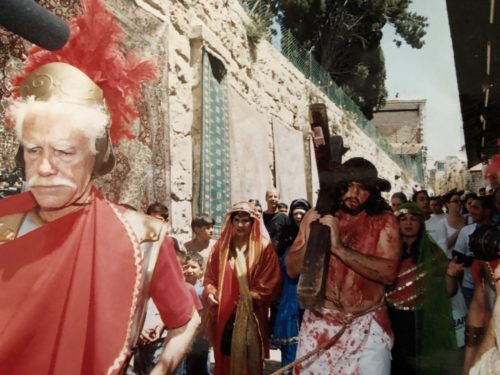
Our ministry’s work in Jerusalem centers on reenacting the carrying of the Cross down the Via Dolorosa on Good Friday — and I will never forget what happened to us several years ago. Someone forgot to pack Jesus’s wig and the stage blood.
The night before Good Friday, we always hold a rehearsal to make sure every participant knows their part. When Joanne asked about the wig and stage blood, we all looked at each other in a panic. Someone had dropped a really big ball. That night, I was assigned the task of going through everyone’s suitcase searching for both — and came up empty.
Early Good Friday morning, one of the women traveling with us — who happens to wear wigs — offered to sacrifice one of her own for Jesus. Literally. There was just one problem: it was blonde. We needed hair dye, but it was a Jewish holiday and every store was closed.
That’s when Caleb came through. A longtime Arab friend of the ministry, Caleb heard about our dilemma and didn’t hesitate. “I have a cousin who owns a beauty shop just down the street,” he said. There was no time to waste — Jim and I jumped into Caleb’s old car and headed down the road, with Caleb trying to sell us jewelry the entire way.
Caleb’s cousin’s shop sat above the Mount of Olives gift shop. The place was packed with Arab women getting beauty treatments, and they did not take kindly to our intrusion — a full-blown cultural faux pas. Caleb did all the talking, and for six dollars we walked out with a container of brown hair dye and an applicator brush.
When we got back, Joanne took one look at it and nervously barked, “This is not enough!” Jim and I had to turn right back around — only this time, Caleb was nowhere to be found. We ran up and down hills for what had to be over a mile.
When we walked back into the shop, the atmosphere was ice cold. The air was thick with anti-American glares. I started to explain that we needed more dye when a strange woman shot up from her chair and started yelling at me. I couldn’t understand a single word, but it was no welcoming speech. Her black eyes and wet hair gave the whole scene an eerie feeling. My only thought was to get that hair dye — because the retribution waiting back at the hotel was going to be far worse than anything this woman could dish out.
Caleb’s cousin had turned cold as well and wanted nothing to do with us. I pleaded with her using every hand gesture I had, desperately trying to communicate how much we needed that solution. The strange woman kept at it, trying to talk her out of helping us. I knew Jim was praying — because somehow, Caleb’s cousin finally gave in.
As she handed it over, she looked at us and said, “Twenty dollars.” For just a few seconds, the urge to give her a piece of my mind in Arabic was real — but we didn’t have a minute to waste. We also didn’t have cab fare, having not brought any extra money. So we ran.
The stage blood was a whole other drama. Victor (Joanne’s son) and I headed down to the hotel kitchen and recruited some of the waiters and cooks to help us figure it out. The only red ingredient anyone could find was something that looked like Kool-Aid. We mixed it with water, but it came out far too watery. We kept adding more red dye until it slightly clumped up — and that was the best we could do.
By the time the bus pulled up to take us to the Via Dolorosa, I was worn out. I applied the fake Kool-Aid blood to Joseph — a man from Croatia who was playing the part of Jesus that year. Joanne was not happy. The mixture had taken on a color somewhere between pink and red. But we had done our best, and we had saved the day. We came to do the Lord’s work, and nothing was going to stand in the way of that calling.