
Kristafori: Young Witnesses Making a Mark for Christ
They call themselves Kristafori, and they are young—a generation awakened to their call as witnesses for Christ in their nation. They are making an undeniable mark.
As guests, we were treated with a level of hospitality that transcends the ordinary. It is an indescribable love—the kind that flows not from social obligation or courtesy, but from genuine communion in Christ. This is what happens when young people grasp the truth: that their faith is not something to hide or minimize, but to live boldly and share generously.
The Kristafori embody what Saint Paul calls believers to be: “Therefore, as God’s chosen people, holy and dearly loved, clothe yourselves with compassion, kindness, humility, gentleness and patience” (Colossians 3:12). Their hospitality isn’t calculated. It’s the natural overflow of hearts set on fire by the Holy Spirit.
This generation—young, passionate, willing to sacrifice—represents the future of the Church in Croatia. They are not waiting for someone else to evangelize their nation. They are doing it. They are the answer to countless prayers for revival and renewal.
When you receive such love from them, you are receiving a gift that goes beyond comfort or convenience. You are being welcomed into a spiritual family, united by the blood of Christ and the mission of His Church.

The Musicians: Vessels of Heaven’s Song
The musicians have recorded several CDs, and their voices command reverence—they do not demand attention for themselves, but draw souls into the presence of God. Their singing is not performance; it is intercession made audible.
They are holy. They operate in unity. Each one knows their place in God’s design and surrenders to it completely. Throughout the entire prayer session—sometimes lasting more than two hours—they sing without ceasing. And remarkably, the songs remain as fresh, as alive, as powerful in the final hour as they were in the first.
This is praise and worship at its finest.
What you are witnessing is not talent, though they certainly possess it. What you are witnessing is consecration. These musicians have yielded their gifts so completely to the Holy Spirit that their voices become channels through which heaven breaks through. Saint Paul wrote, “Whether you eat or drink or do whatever you do, do it all for the glory of God” (1 Corinthians 10:31). The Kristafori musicians live this truth. Every note, every breath, every phrase is an offering laid at Christ’s feet.
The fact that their voices remain fresh for two hours reveals something crucial: they are not drawing from human energy or technique. They are drawing from an infinite well—the Holy Spirit Himself. When the Source is limitless, the vessel never runs dry.
This is why their music commands reverence. People sense that they are in the presence of something sacred, something true. The music becomes a bridge between the temporal and the eternal, between human brokenness and divine healing.
The unity among them is also non-negotiable. Division in worship fractures the anointing. But when musicians stand as one body, one heart, one voice—offering everything to Christ—the atmosphere shifts. Demons flee. Angels draw near. God’s presence becomes palpable.

Leadership, Vision, and Faithful Succession
Danijel Katanovic leads this fast-growing movement—one that originally began under the vision of Josip Loncar. Loncar has since moved to a larger calling within God’s Kingdom, and the work continues to flourish under Katanovic’s faithful stewardship. This is the pattern of the Church: vision passed from one generation to the next, each leader pouring into their successor, the mission never stopping but always advancing.
The Protocol: Teaching, Singing, Praying
The team followed the same proven protocol as the previous nights. Joanne’s teaching on understanding purpose and calling set the spiritual foundation. She helped people grasp a crucial truth: that every baptized Christian has a vocation, a specific calling from God. This is not reserved for priests and religious. Everyone is called. Everyone has a place in God’s plan.
Then came the singing—those fresh, anointed voices drawing souls into reverence and openness to the Holy Spirit.
Then came the praying. And this night, every single person in the crowd came forward for prayer. No one held back. No one remained seated. The entire gymnasium responded to the invitation to encounter Christ.
The Team: Interpreter, Catcher, Counselor
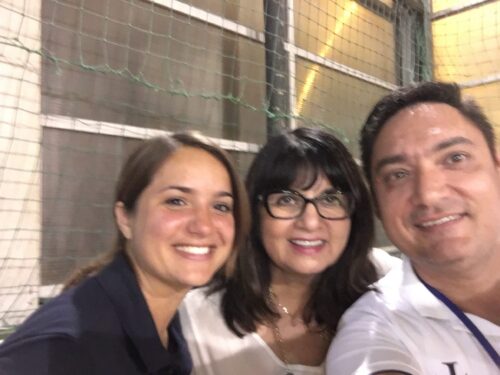
Magdalena served as your interpreter, translating not just language but spiritual meaning—ensuring that nothing was lost between the spoken word and the hearer’s heart. Darko stood as the catcher, vigilant and steady, holding sacred space for God’s work.
.
A Culture Rooted in Truth: Food, Language, and the Rhythm of Life
It was midnight before the team was finally urged to leave. Exhausted but spiritually full, you settled for a familiar dinner—McDonald’s—but discovered something remarkable: even the burgers taste better in Croatia.
Why? Because this nation remains free from genetic modification. The food here is real. The watermelon you had for breakfast came with old-fashioned seeds—laborious to remove, but the flavor is incomparably richer and healthier. The grapes are sweet and seeded. This is not accident; it is choice. The Croatians have resisted the technological alteration of creation and chosen to honor God’s design.
Most of the people you’ve met maintain their own vegetable gardens. Your hotel serves only fresh-picked goods. This is not nostalgia or quaintness—it is a living commitment to stewardship, to eating what God created rather than what corporations engineered. There is profound theology in this: a nation that refuses to tamper with creation is a nation that still remembers God’s authority over the natural order.
Language: The Beauty of Difficulty
The Croatians have a particular love for the letters “K,” “J,” and “H”—and they deploy accent marks with zealous precision. The names you’ve encountered—Danijel, Josip, Darko, Magdalena—carry a musical quality that reflects the soul of the language.
The shorter, familiar names you recall—Anna, Mimka, Milka—are easier on the foreign tongue. But the longer names, though challenging to pronounce, possess a beautiful sound that cannot be rushed or simplified. They demand respect, attention, presence.
Economics and Independence
Croatia is not yet part of the European Union. They maintain their own currency, the kuna, which trades at approximately six kuna to one dollar. This independence—economic and otherwise—reflects a people still finding their way, still building their own identity in the post-Cold War era. There is something admirable in this: a nation that has not simply surrendered to larger powers but insists on charting its own course.
All of this—the food free from genetic alteration, the preserved language, the independent currency—speaks to a people who have learned, through suffering and history, to protect what is true. They know the cost of losing cultural and spiritual identity. They refuse to make that mistake again.
